What this movie is
Nolan filmed Homer. The plot is the one you half-remember from school: Odysseus, king of Ithaca, spends ten years trying to get home from the Trojan War, losing ships and men along the way. At home he is presumed dead. Suitors have taken over the palace and circle his wife Penelope, while his grown son Telemachus sets out to find his father.
The cast looks like an Oscar ceremony seating chart. See for yourself:
 Matt DamonOdysseus
 Anne HathawayPenelope
 Robert PattinsonAntinous
 Tom HollandTelemachus
 ZendayaAthena
 Samantha MortonCirce
 Charlize TheronCalypso
 Lupita Nyong'oHelen / Clytemnestra
 Elliot PageSinon
Holland and Zendaya managed to headline both of the summer's biggest movies: the new Spider-Man opened two weeks after The Odyssey with both of them in it. Behind the camera it's the Oppenheimer team: cinematographer Hoyte van Hoytema (Interstellar, Dunkirk) and composer Ludwig Göransson, who already owns three Oscars. Shot on IMAX cameras, runs 172 minutes.
Now the numbers, so we don’t manufacture suspense. The film was received extremely well. It opened to $124.5 million in the US and $264 million worldwide, Nolan’s biggest global launch ever, ahead of The Dark Knight Rises. Critics have it at 94% on Rotten Tomatoes, audiences at 96%, with an “A” CinemaScore. On paper this is among the best-reviewed films of Nolan’s career. But inside that success there are several live arguments. Which side of each one you land on decides whether you get your film of the year or just three beautiful hours.
What almost everyone praises
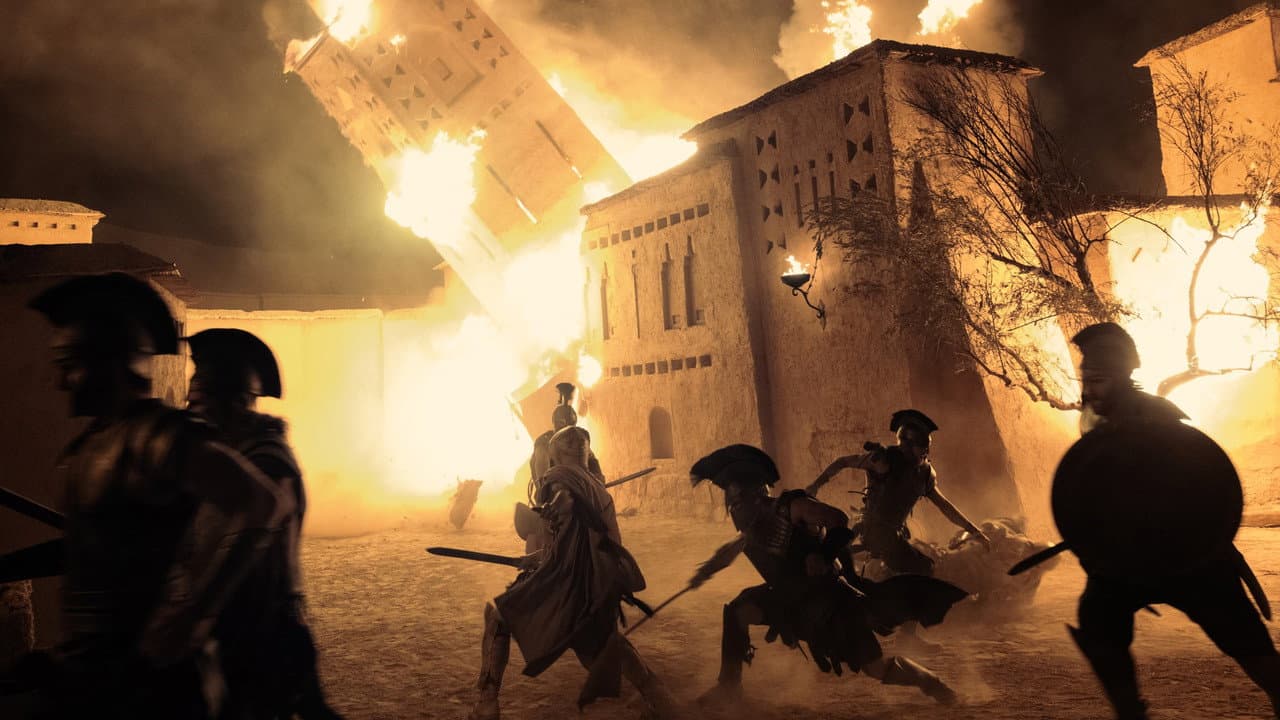
The look. “Every frame looks like a painting” — lines like that fill the reviews, and more than one outlet calls this the best cinematography of van Hoytema’s career. The Cyclops scene and the Sirens’ song are already being filed under future classics.
The score. For a number of critics, Göransson’s score is the film’s single biggest achievement. He’s being tipped for a fourth Oscar, and winning the composing statuette two years in a row is something almost nobody in the history of the award has done.
Damon. Praised for restraint. Critics single out his restraint: an understated, grounded performance that keeps the gods and monsters tied to something human.
And the theater itself. Critics are close to unanimous here: see it on the biggest screen available, skipping IMAX would be a mistake. Even the reserved reviews agree the film will lose half its meaning at home.
What the arguments are about
Argument one: this isn't that Nolan
The Odyssey is told more simply than most Nolan films. No big twist, and the time-shuffling is nested stories rather than a puzzle. For some critics that’s the point: it’s a blockbuster that respects the audience. For others it means Nolan losing his signature: the simplicity makes the film accessible but strips away the conceptual spark Nolan is loved for, and the “obvious flashbacks” don’t play in the same league as Tenet or Dunkirk. If puzzles are what you go to Nolan for, adjust your expectations: by most accounts this is a more classical Nolan, an epic first and a puzzle second.
Argument two: the action
An unexpected weak spot. Several reviews independently describe the final battle as choppy and poorly staged; the harshest verdicts call the action difficult to follow. The same critics praise the sea sequences and the Cyclops. The spectacle here runs on scale and atmosphere; the fight choreography lags behind. Go in knowing that.
Argument three: Holland
Opinions on him split harder than on any other actor: half the reviews call Telemachus the best work of Holland’s career outside Spider-Man, the other half call it one of the year’s most miscast performances, an actor who never gets on the same wavelength as his scene partners. There is almost no middle. Your own feelings about Holland as an actor are an honest predictor here.
Argument four: the women
This fight has history: Nolan has been criticized for years for writing women who exist to serve the hero’s story. Some reviewers think he finally fixed it here — Penelope, Circe and Athena stop being footnotes, and Hathaway gets called the best thing in the film. The other camp’s problem is with the roles, not the actresses: Homer’s women are cunning and powerful, while the film hands them the position of “divine set dressing.” A useful reference point is Madeline Miller, the author of the bestseller Circe, who said on The Daily that in Homer’s text Penelope “is absolutely meant to be brilliant”; some critics argue the film dims that brilliance. Notice that both camps praise the performances. The argument is about what the women were given to play.
Argument five: the darkness
Literal darkness in the frame. Part of the film is shot in deep black, and reviewers complain about it outright: “too dark and monochromatic.” The defense says it’s the design — a film about isolation should look like flickering flame in the dark. If “I can’t see anything” in late-era blockbusters drives you up the wall, you’ll meet it here too.
Common questions
How do the three hours feel?
Lighter than they sound. Many reviews say it moves faster than its 172-minute runtime suggests, and the editing earns it. An honest minority reports sagging around the middle. The runtime is scarier going in than it is once you’re in the seat.
Do I need to know Homer?
No. The story runs on two tracks, father and son, converging at the end, and it works with zero homework. If you know the poem you’ll catch an extra layer, plus the anachronisms that annoy purists. But the film doesn’t check tickets at the door.
Do I need to watch Troy first?
No. The films are unrelated: Troy came out in 2004 with a different director, a different studio and its own take on the myths. All they share is Homer’s universe. In myth chronology Troy covers the war Odysseus is coming home from, so you can treat it as an optional prequel. Everything you need to know about the war, Nolan’s film shows you itself. Odysseus is in Troy too, played by Sean Bean — consider it an unofficial passing of the torch to Damon.
Is IMAX worth the upcharge?
If you’re going at all, yes. This is the rare case where the format is part of the design, and even the reserved reviews agree on that. At home it’s just a long movie.
So is it worth watching
Yes, if you love big, slow cinema. If Nolan the storyteller interests you more than Nolan the puzzle-maker. If you can get to a big screen — this is the film that made critics reach for the word “event” again.
Probably not, if you’re expecting Inception in ancient Greece: there are no twists, by design. If you’re going for the battle scenes — by critical consensus, they’re the weakest part. And if three hours of unhurried myth sounds like an endurance test, the reviews chanting “theater only” won’t help you.
Tired of picking films by other people's ratings?
MyKinoList predicts your own. Start by rating a few films you've already seen.